Author: A. Hyatt Verrill 1871-1954Editor Popular Science Dept., "American Boy Magazine." Illustrated with 156 Original Cuts Showing How Each Knot, Tie or Splice is Formed and Its Appearance When Complete.
Giving Complete and Simple Directions for Making All the Most Useful and Ornamental Knots in Common Use, with Chapters on Splicing, Pointing, Seizing, Serving, etc. Adapted for the Use of Travellers, Campers, Yachtsmen, Boy Scouts, and All Others Having to Use or Handle Ropes for Any Purpose.
Parts of Rope. Whipping and Seizing Rope. Loops. Cuckolds' Necks. Clinches. Overhand and Figure-eight Knots. Square and Reef Knots. Granny Knots. Open-hand and Fishermen's Knots. Ordinary Knots and Weavers' Knots. Garrick Bends and Hawser Hitches. Half-hitches.
Larks' Heads. Slippery and Half-hitches. Clove Hitches. Gunners' Knots and Timber Hitches. Twists, Catspaws, and Blackwall Hitches. Chain Hitch. Rolling and Magnus Hitches. Studding-sail and Gaff-topsail Halyard Bends. Roband and Fisherman's Hitches.
Two-, Three-, and Fivefold Shortenings. Single Plaits and Monkey Chain. Twist Braids and Braiding Leather. Open Chains. Seized and Bow Shortenings. Sheepshanks and Dogshanks. Grommets. Selvagee Straps and Selvagee Boards. Flemish and Artificial Eyes. Throat Seizings. Lashed Splices.
Wedding Knots and Rose Lashings. Deadeye and Loop Lashings. Belaying-pin Splice. Necklace Ties. Close Bands and End Pointing. Ending Ropes. Short Splices. Long Splices. Eye and Cut Splices.
Single Crown Knots. Tucked Crowns. Single Wall Knots. Common and French Shroud Knots. Double Crown and Double Wall Knots. Crowning Wall Knots. Double Wall and Crown. Manrope Knots. Topsail-halyard Toggles. Matthew Walker and Stopper Knots. Turks' Heads and Turks' Caps. Worming, Parcelling, and Serving. Serving Mallet. Half-hitch Work. Four-strand and Crown Braids. Rope Buckles and Swivels. Slinging Casks and Barrels. Rope Belting.
Simple but effective way of making cordage from natural fibres
How to make rope, cordage, and twine from natural materials found in the wilderness.
CORDAGE
Before taking up the matter of knots and splices in detail it may be well to give attention to cordage in general. Cordage, in its broadest sense, includes all forms and kinds of rope, string, twine, cable, etc., formed of braided or twisted strands.
In making a rope or line the fibres (A, Fig. 1) of hemp, jute, cotton, or other material are loosely twisted together to form what is technically known as a "yarn" (B, Fig. 1). When two or more yarns are twisted together they form a "strand" (C, Fig. 1). Three or more strands form a rope (D, Fig. 1), and three ropes form a cable (E, Fig. 1). To form a strand the yarns are twisted together in the opposite direction from that in which the original fibres were twisted; to form a rope the strands are twisted in the opposite direction from the yarns of the strands, and to form a cable each rope is twisted opposite from the twist of the strands. In this way the natural tendency for each yarn, strand, or rope to untwist serves to bind or hold the whole firmly together (Fig. 1).
Rope is usually three-stranded and the strands turn from left to right or "with the sun," while cable is left-handed or twisted "against the sun" (E, Fig. 1). Certain ropes, such as "bolt-rope" and most cables, are laid around a "core" (F, Fig. 2) or central strand and in many cases are four-stranded (Fig. 2).
The strength of a rope depends largely upon the strength and length of the fibres from which it is made, but the amount each yarn and strand is twisted, as well as the method used in bleaching or preparing the fibres, has much to do with the strength of the finished line.
Roughly, the strength of ropes may be calculated by multiplying the circumference of the rope in inches by itself and the fifth part of the product will be the number of tons the rope will sustain. For example, if the rope is 5 inches in circumference, 5 X 5 = 25, one-fifth of which is 5, the number of tons that can safely be carried on a 5-inch rope. To ascertain the weight of ordinary "right hand" rope, multiply the circumference in inches by itself and multiply, the result by the length of rope in fathoms and divide the product by 3.75. For example, to find the weight of a 5-inch rope, 50 fathoms in length: 5 X 5 = 25; 25 x 50 = 1,250; 1,250 ÷ 3.75 = 333-1/3 lbs. These figures apply to Manila or hemp rope, which is the kind commonly used, but jute, sisal-flax, grass, and silk are also used considerably. Cotton rope is seldom used save for small hand-lines, clothes-lines, twine, etc., while wire rope is largely used nowadays for rigging vessels, derricks, winches, etc., but as splicing wire rope is different from the method employed in fibre rope, and as knots have no place in wire rigging, we will not consider it.
For convenience in handling rope and learning the various knots, ties, and bends, we use the terms "standing part," "bight," and "end" (Fig. 3). The Standing Part is the principal portion or longest part of the rope; the Bight is the part curved or bent while working or handling; while the End is that part used in forming the knot or hitch. Before commencing work the loose ends or strands of a rope should be "whipped" or "seized" to prevent the rope from unravelling; and although an expert can readily tie almost any knot, make a splice, or in fact do pretty nearly anything with a loose-ended rope, yet it is a wise plan to invariably whip the end of every rope, cable, or hawser to be handled, while a marline-spike, fid, or pointed stick will also prove of great help in working rope.
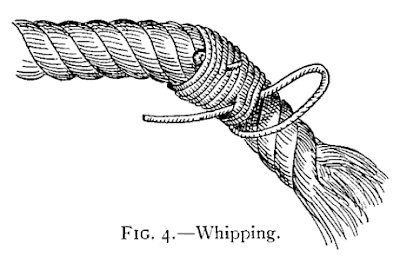
To whip or seize a rope-end, take a piece of twine or string and lay it on the rope an inch or two from the end, pass the twine several times around the rope, keeping the ends of the twine under the first few turns to hold it in place; then make a large loop with the free end of twine; bring it back to the rope and continue winding for three or four turns around both rope and end of twine; and then finish by drawing the loop tight by pulling on the free end (Fig. 4).
All knots are begun by "loops" or rings commonly known to mariners as "Cuckolds' Necks" (Fig. 5).
These may be either overhand or underhand, and when a seizing or fastening of twine is placed around the two parts where they cross a useful rope ring known as a "clinch" is formed (Fig. 6).
If the loose end of the rope is passed over the standing part and through the "cuckold's-neck," the simplest of all knots, known as the "Overhand Knot," is made (Fig. 7). This drawn tight appears as in Fig. 8, and while so simple this knot is important, as it is frequently used in fastening the ends of yarns and strands in splicing, whipping, and seizing.
The "Figure-Eight Knot" is almost as simple as the overhand and is plainly shown in Figs. 9 and 10.
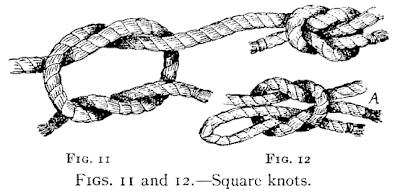
Only a step beyond the figure-eight and the overhand knots are the "Square" and "Reefing" knots (Figs. 11 and 12). The square knot is probably the most useful and widely used of any common knot and is the best all-around knot known. It is very strong, never slips or becomes jammed, and is readily untied. To make a square knot, take the ends of the rope and pass the left end over and under the right end, then the right over and under the left.
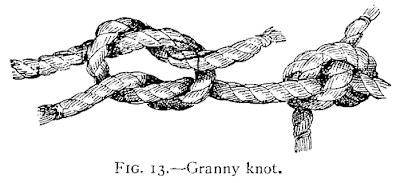
If you once learn the simple formula of "Left over," "Right over," you will never make a mistake and form the despised "Granny," a most useless, bothersome, and deceptive makeshift for any purpose (Fig. 13). The true "Reef Knot" is merely the square knot with the bight of the left or right end used instead of the end itself. This enables the knot to be "cast off" more readily than the regular square knot (A, Fig. 12).
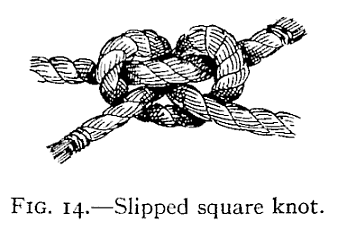
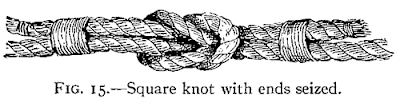
Neither square nor reef knots, however, are reliable when tying two ropes of unequal size together, for under such conditions they will frequently slip and appear as in Fig. 14, and sooner or later will pull apart.
To prevent this the ends may be tied or seized as shown in Fig. 15.
A better way to join two ropes of unequal diameter is to use the "Open-hand Knot." This knot is shown in Fig. 16, and is very quickly and easily made; it never slips or gives, but is rather large and clumsy, and if too great a strain is put on the rope it is more likely to break at the knot than at any other spot.
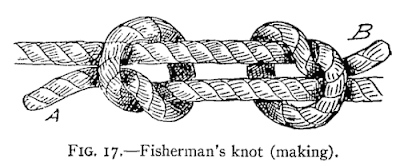
The "Fisherman's Knot," shown in Fig. 17, is a good knot and is formed by two simple overhand knots slipped over each rope, and when drawn taut appears as in Fig. 18.
This is an important and valuable knot for anglers, as the two lines may be drawn apart by taking hold of the ends, A, B, and a third line for a sinker, or extra hook, may be inserted between them. In joining gut lines the knot should be left slightly open and the space between wrapped with silk. This is probably the strongest known method of fastening fine lines.
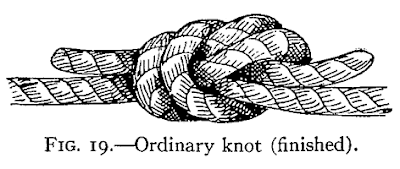
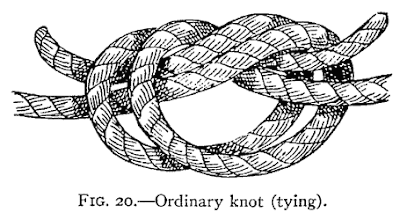
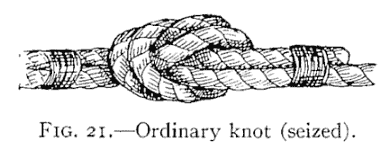
The "Ordinary Knot," for fastening heavy ropes, is shown in Fig. 19.
It is made by forming a simple knot and then interlacing the other rope or "following around," as shown in Fig. 20. This knot is very strong, will not slip, is easy to make, and does not strain the fibres of the rope. Moreover, ropes joined with this knot will pay out, or hang, in a straight line.
By whipping the ends to the standing parts it becomes a neat and handsome knot (Fig. 21).
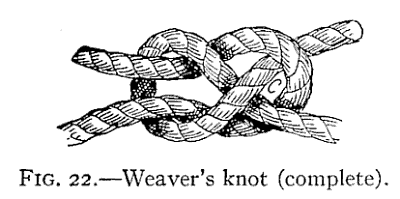
The "Weaver's Knot" (Fig. 22) is more useful in joining small lines, or twine, than for rope, and for thread it is without doubt the best knot known.
The ends are crossed as in Fig. 23. The end A is then looped back over the end B, and the end B is slipped through loop C and drawn tight.
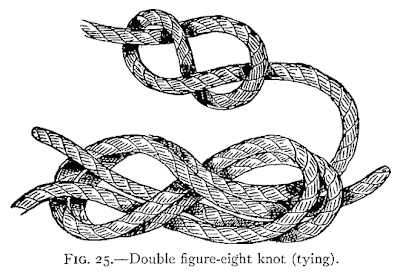
Another useful and handsome knot is illustrated in Fig. 24. This is a variation of the figure-eight knot, already described, and is used where there is too much rope, or where a simple knot is desired to prevent the rope running through an eye, ring, or tackle-block.
It is made by forming a regular figure eight and then "following round" with the other rope as in Fig. 25. It is then drawn taut and the ends seized to the standing part if desired.
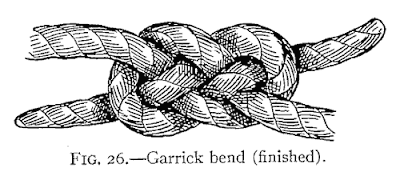
Sometimes we have occasion to join two heavy or stiff ropes or hawsers, and for this purpose the "Garrick Bend" (Fig. 26) is preeminently the best of all knots. To make this knot, form a bight by laying the end of a rope on top of and across the standing part.
Next take the end of the other rope and pass it through this bight, first down, then up, over the cross and down through the bight again, so that it comes out on the opposite side from the other end, thus bringing one end on top and the other below, as illustrated in Fig. 27. If the lines are very stiff or heavy the knot may be secured by seizing the ends to the standing parts.
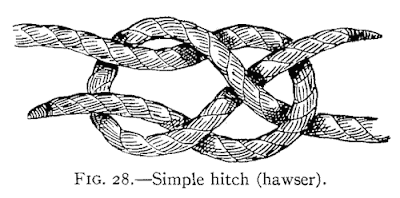
A much simpler and a far poorer knot is sometimes used in fastening two heavy ropes together. This is a simple hitch within a loop, as illustrated in Fig. 28, but while it has the advantage of being quickly and easily tied it is so inferior to the Garrick bend that I advise all to adopt the latter in its place.
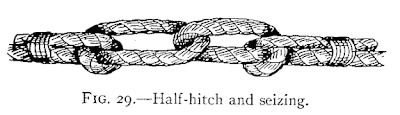
When two heavy lines are to be fastened for any considerable time, a good method is to use the "Half-hitch and Seizing," shown in Fig. 29. This is a secure and easy method of fastening ropes together and it allows the rope to be handled more easily, and to pass around a winch or to be coiled much more readily, than when other knots are used.
All the knots I have so far described are used mainly for fastening the two ends of a rope, or of two ropes, together. Of quite a different class are the knots used in making a rope fast to a stationary or solid object, and are known as "hitches" or "ties."
One of the easiest of this class to make and one which is very useful in fastening a boat or other object where it may be necessary to release it quickly is the "Lark's Head" (Fig. 30). To make this tie, pass a bight of your rope through the ring, or other object, to which you are making fast and then pass a marline-spike, a billet of wood, or any similar object through the sides of the bight and under or behind the standing part, as shown in A, Fig. 30.
The end of the rope may then be laid over and under the standing part and back over itself. This knot may be instantly released by merely pulling out the toggle.
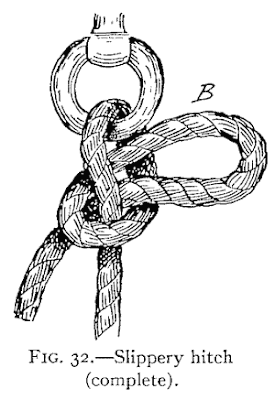
Almost as quickly made and unfastened is the "Slippery Hitch" (Fig. 32).
To make this, run the end of the rope through the ring or eye to which it is being fastened, then back over the standing part and pull a loop, or bight, back through the "cuckold's neck" thus formed (Fig. 33). To untie, merely pull on the free end.
Two half-hitches, either around a post or timber or around the standing part of the rope, make an ideal and quickly tied fastening (Figs. 34 and 35). To make these, pass the end around the post, ring, or other object, then over and around the standing part between the post and itself, then under and around the standing part and between its own loop and the first one formed. After a little practice you can tie this knot almost instantly and by merely throwing a couple of turns around a post, two half-hitches may be formed instantly. This knot will hold forever without loosening, and even on a smooth, round stick or spar it will stand an enormous strain without slipping.
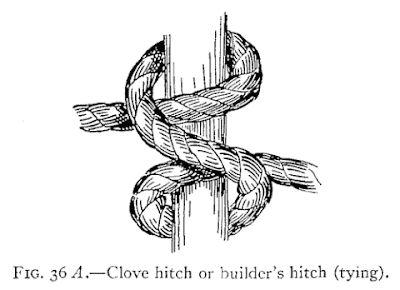
A more secure knot for this same purpose is the "Clove Hitch" (Fig. 36), sometimes known as the "Builders' Hitch."
To make this, pass the end of rope around the spar or timber, then over itself; over and around the spar, and pass the end under itself and between rope and spar, as shown in the illustration.
The Clove hitch with ends knotted becomes the "Gunners' Knot" (Fig. 37). These are among the most valuable and important of knots and are useful in a thousand and one places. The Clove hitch will hold fast on a smooth timber and is used extensively by builders for fastening the stageing to the upright posts. It is also useful in making a tow-line fast to a wet spar, or timber, and even on a slimy and slippery spile it will seldom slip.
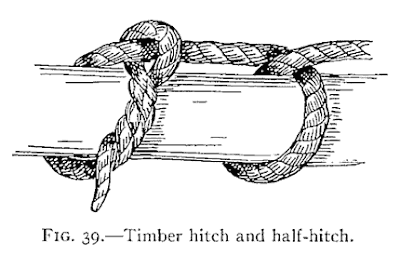
For this purpose the "Timber Hitch" (Fig. 38) is even better than the Clove hitch. It is easily made by passing the end of a rope around the spar or log, round the standing part of the rope and then twist it three or more times around, under and over itself.
If you wish this still more secure, a single half-hitch may be taken with the line a couple of feet further along the spar (Fig. 39).
It is remarkable what power to grip a twisted rope has, and the "Twist Knots" shown in Figs. 40 and 41 illustrate two ways of making fast which are really not knots at all but merely twists.
These may be finished by a simple knot, or a bow-knot, as shown in Fig. 42, but they are likely to jam under great pressure and are mainly useful in tying packages, or bundles, with small cord, where the line must be held taut until the knot is completed.
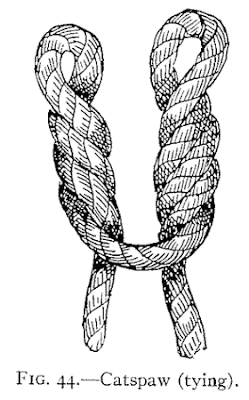
This principle of fastening by twisted rope is also utilized in the "Catspaw" (Fig. 43), a most useful knot or "hitch" for hoisting with a hook.
To make this, pass the bight of your rope over the end and standing part, then, with a bight in each hand, take three twists from you, then bring the two bights side by side and throw over the hook (Fig. 44).
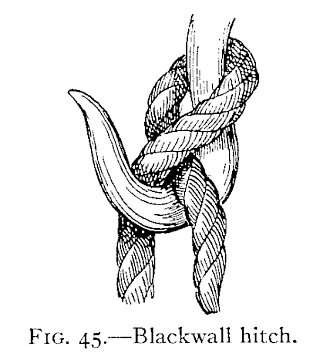
The "Blackwall Hitch" (Fig. 45) is still simpler and easier to make and merely consists of a loop, or cuckold's neck, with the end of rope passed underneath the standing part and across the hook so that as soon as pressure is exerted the standing part bears on the end and jams it against the hook.
The "Chain Hitch" (Fig. 46) is a very strong method of fastening a line to a timber, or large rope, where one has a rope of sufficient length, and is used frequently to help haul in a large rope or for similar purposes.
It consists simply of a number of half-hitches taken at intervals around the object and is sometimes used with a lever or handspike, as shown in Fig. 47.
The "Rolling Hitch" is a modified Clove hitch and is shown in Fig. 48.
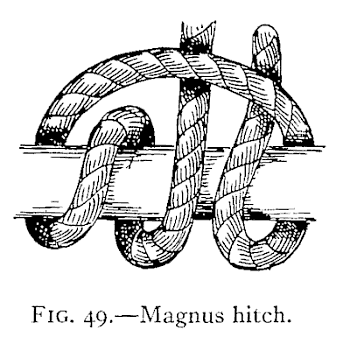
The "Magnus Hitch" (Fig. 49) is a method frequently used on shipboard for holding spars;
and the "Studding-sail Bend" (Fig. 50) is also used for this purpose.
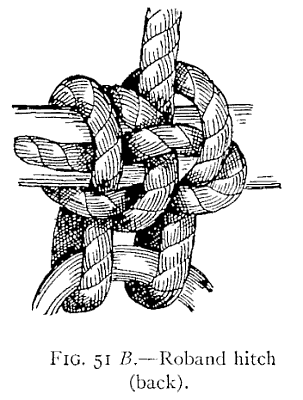
Occasions sometimes arise where a tackle, hook, ring, or another rope must be fastened to a beam by the same rope being used, and in such cases the "Roband Hitch" (Fig. 51) comes in very handy.
These are all so simple and easily understood from the figures that no explanation is necessary.
Almost as simple are the "Midshipman's Hitch" (Fig. 52), the "Fisherman's Hitch" (Fig. 53), and the "Gaff Topsail Halyard Bend" (Fig. 54). The midshipman's hitch is made by taking a half-hitch around the standing part and a round turn twice around above it.
The fisherman's hitch is particularly useful in making fast large hawsers; with the end of a rope take two turns around a spar, or through a ring; take a half-hitch around the standing part and under all the turns; then a half-hitch round the standing part only and if desired seize the end to standing part.
The gaff-topsail bend is formed by passing two turns around the yard and coming up on a third turn over both the first two turns; over its own part and one turn; then stick the end under the first turn.
Wikipedia Knots - A knot is a method for fastening or securing linear material such as rope by tying or interweaving. It may consist of a length of one or more segments of rope, string, webbing, twine, strap, or even chain interwoven such that the line can bind to itself or to some other object—the "load". Knots have been the subject of interest for their ancient origins, their common uses, and the mathematical implications of knot theory.
The Bowline is one of the most used loop knots. At the end of a rope, the bowline forms a strong loop that will not slip or jam. Most of the time however, the bowline is used when ever we have a competition on who can tie it the fastest around their waist. Which is always fun.
The Square Knot is probably the best known and most widely used knot. It serves to join the ends of two ropes, and has the advantage of strength and ease of tying and untying. It slips or jams only if pulled around a corner. People use square knots to tie packages and to fasten towing lines, it is also called the "first aid knot." Most people use a variation of the square knot to tie their shoes. An improperly tied square knot is called a granny knot. A granny knot may come loose under pressure and should not be used.
Two Half Hitches are used to fasten a rope temporarily to a post, hook, or ring. The Boy Scout book says this is a good not for tying your tent down, or for tying a clothes line to hang wet clothes and towels. This not is usually used because of it's slip feature. The knot slides with the greatest of ease, to make the loop bigger or smaller.
The Sheet Bend was a knot that the sailors used to tie on their ships. They tied the sails together, which were sheets. This is a good choice when tying two ropes together, especially when the ropes are different sizes.
The Taut-line Hitch. This is a remarkably useful knot; it's adjustable AND trustworthy. Anyone who uses a tent should know this knot. It is the best way to adjust your lines to the tent-poles. It is the most simple of the adjustable knot family.
The Clove Hitch. This is a very important knot, especially in your lashings. Make sure you work it up properly; pull lengthwise only at both ends. If you pull the knot at different angles, it's likely to become unreliable. If you use it be sure that both ends are pulled straight out.
The Timber Hitch is used to attach a rope to a log. This knot tightens under strain, but comes undone extremely easily when the rope is slack. So be sure to keep it tight. The timber hitch is very useful for dragging logs back to the camp fire, or clearing forest.
The Figure-Eight. This knot is larger, stronger and more easy to untie than the overhand knot. It does not harm your rope as much as the overhand knot does. So therefore sailors use this knot in most cases. Other than that, I see no use for it, other than impressing you board of review.